
01
Standardised, continuous processes
A continuous material flow, minimal manual intervention and short cycle and handover times reduce losses that would otherwise add up massively across high production volumes.
Production Lines for Mass Production
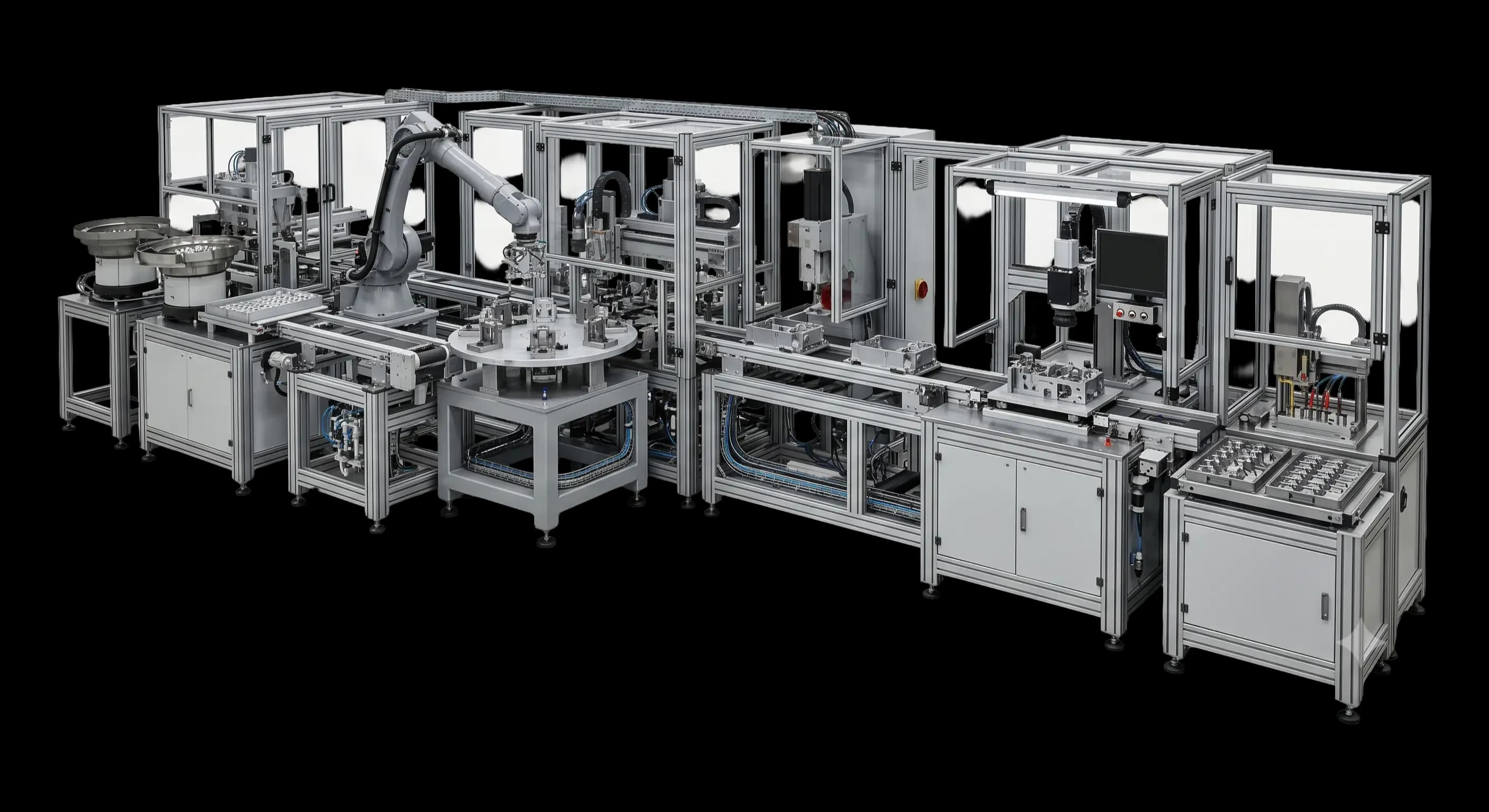
assemblean develops manufacturer-independent production lines for mass production, precisely tailored to your product, target volume and quality requirements. We combine special-purpose machinery, robotics, feeding technology, inspection technology, intralogistics and industrial software into one turnkey manufacturing solution.
Service overview
What matters is not the speed of a single machine alone. Only the precise interaction of all stations ensures that products can be manufactured permanently at consistent quality and without avoidable interruptions. The result is scalable mass production with high equipment availability, controlled manufacturing costs and maximum transparency across the entire value stream.
A high-performance mass production line must be able to produce high volumes permanently without quality, process stability or maintainability suffering. Several core areas must be met simultaneously.
| Analysis parameter | Relevance for Mass Production | Technical Implementation |
|---|---|---|
| Short Cycle Times | High output per hour and shift | Parallel processes, fast robotics and optimised motion sequences |
| High Availability | As few unplanned production interruptions as possible | Condition monitoring, redundancies and maintenance-friendly modules |
| Reproducible Quality | Consistent products across millions of cycles | Process monitoring, inline metrology and statistical quality control |
| Automatic Material Flow | Continuous supply to all stations | Feeding technology, conveyor systems, buffers and intelligent intralogistics |
| Low Unit Costs | Economical production of high volumes | Automation, short auxiliary times and efficient resource use |
| Scalable Capacity | Adaptation to rising sales volumes | Modular line concepts and parallelisable process stations |
| Digital Traceability | Documentation of every product and process step | Serial numbers, traceability and MES/ERP connection |
In mass production, even small losses per component significantly affect total costs. A few extra seconds of cycle time, recurring micro-stops or a slightly elevated scrap rate can cause high costs across large production volumes.
Automated production lines systematically reduce these losses by standardising process flows, shortening auxiliary times and securing consistent repeatability.
A continuous material flow, minimal manual intervention and short cycle and handover times reduce losses that would otherwise add up massively across high production volumes.
Automated quality inspections lower scrap and rework costs, since defects are detected directly in the process instead of only at the end of the line.
Controlled tool and equipment conditions secure high technical availability and prevent costly, unforeseen downtime.
Automated operating data acquisition enables optimal utilisation of personnel and equipment. Economic efficiency thus arises from optimising the entire production chain, not just individual activities.
Planning a mass production line begins with the product and the required annual volume. From this we derive the necessary line output, the ideal cycle time and the required number of parallel processes.
A line should not be designed exactly for the theoretically necessary minimum output — it needs a robust performance reserve to compensate for fluctuations and unavoidable losses.
Target volume per year, month, shift and hour, the available net production time, the required cycle time and the desired OEE form the basis of every capacity plan.
Material changes, tool changes, inspection times, maintenance windows, disruptions, shift models and planned production breaks all flow into capacity planning — not just the theoretical machine cycle.
assemblean analyses every process step individually and identifies the line's actual bottleneck. We then optimise machine movements, robot paths, gripping and handover times, parallel process steps, material provisioning, inspection strategies, buffer sizes, loading and unloading operations, and communication and release times.
Inspection and documentation requirements, material supply including empty-container concepts, and the necessary buffer capacities are integrated into equipment planning from the start.
Maintenance and accessibility areas, expansion options and connection to existing production systems ensure the line achieves stable, high output volumes even in real shift operation.
The slowest or most failure-prone process determines the performance of the entire production line. Bottlenecks must therefore be identified and specifically addressed as early as the concept phase.
Time-intensive processes can be distributed across several identical stations. An intelligent distribution system automatically routes products to the currently available station. This increases overall capacity while reducing the impact of a single station failure.
Buffers decouple process stations with different cycle times or availabilities, so brief disruptions at one station do not immediately halt the entire line. Buffer size is dimensioned based on realistic fault and restart times — buffers that are too small do not protect the line sufficiently, while oversized buffers increase floor space, work-in-progress and lead time.
For suitable processes, the line can be built so that individual stations are temporarily bypassed. Products are then routed to an alternative station or a defined rework process, keeping production controllably operational even during maintenance or disruption of individual modules.
The optimal automation technology depends on product geometry, cycle time, process forces, variant count and quality requirements. assemblean selects components on a manufacturer-independent basis — resulting not in a system from a predefined product catalogue, but a technically and economically fitting overall solution.

Delta, SCARA and six-axis industrial robots as well as gantry systems and linear axes handle handling and processing at second-by-second rates.

Rotary indexing and long transfer systems as well as workpiece pallet transfer systems chain all process stations into one synchronised production cycle.

Vibratory and flexible feeding systems as well as automatic palletisers and depalletisers ensure process-reliable, correctly oriented part provisioning.

Servo presses and joining units, dispensing, bonding and potting systems, as well as screwdriving and assembly technology join components reproducibly and reliably.

Industrial machine vision as well as electrical and pneumatic test benches secure quality directly within the production flow.

Laser, welding and marking systems as well as automatic packaging and labelling systems complete the line all the way to shipping readiness.
In mass production, every station must be reliably supplied with material. Missing parts, incorrectly oriented components or empty feeders can stop the entire line — a well-thought-out material flow concept therefore covers the entire route from the load carrier to the finished product.
Automatic raw material provisioning, singulation of bulk material, correctly oriented part feeding, container and tray handling, as well as workpiece pallet circuits and intermediate buffers secure an uninterrupted material supply to every station.
The automatic rejection of defective products, the return of empty containers, and automatic packaging and palletising close the material cycle through to shipping readiness.
Sensors monitor fill levels, material positions and feeder states. Line control detects impending material shortages early and automatically informs operators or higher-level logistics systems.
In mass production, spot-check final inspection is often not sufficient. Defects must be detected as directly as possible at their point of origin, before further processing costs are incurred — which is why we integrate quality inspections directly into the production process.
Depending on the product, checks include dimensions and tolerances, presence and position of components, surfaces, joining forces and torques, tightness, electrical functions, and codes and serial numbers. Results are uniquely assigned to each product, and defective parts are automatically locked or ejected.
Modern lines use measured values directly to regulate upstream processes. If a measuring station detects a gradual dimensional deviation, the system automatically adjusts process parameters — enabling early detection of process drift, less scrap and rework, and longer stable production phases.
Serial numbers, data matrix codes, RFID tags or batch-related markings link each product to material batch, process parameters, measurement and inspection results, and release information. The data can be transferred to MES, ERP or CAQ systems, so affected products can be quickly identified in case of quality issues.
At high production volumes, every minute of downtime causes a measurable output loss. Production lines for mass production therefore require a systematic availability concept.
High OEE is achieved when the line rarely stops unplanned, reaches the intended cycle during runtime, and produces a high proportion of defect-free products. Small losses such as brief sensor stops or delayed material handovers are also taken into account and automatically categorised.
Robust, proven components, maintenance-friendly machine modules, fast diagnostic capabilities, standardised spare parts, automatic fault detection and redundant stations for critical processes protect production against unplanned downtime.
Motor currents, vibrations, temperatures, pressure profiles, tool life and energy consumption are continuously monitored. If a component's behaviour changes, maintenance can react before an unplanned failure occurs — allowing maintenance work to be better scheduled into planned production breaks.
High volumes do not necessarily mean a production line can only manufacture a single product. Through modular tooling, automatic recipe changes and intelligent identification systems, modern mass production lines can process multiple product variants.
Automatic product recognition, programmable robot and axis movements, changeable grippers and tools, flexible feeding technology and automatic parameter sets enable the production of several variants on one line. The right balance between speed and flexibility is defined already during the concept phase.
Additional processing stations, parallel inspection processes, further robots, larger buffer sections or mirroring the entire line enable gradual growth in step with the market. Interfaces, floor space and control architecture are considered as early as possible for this purpose.
Production lines for high volumes are used wherever products must be manufactured reproducibly, economically and with high process reliability.

High volumes must be combined with end-to-end traceability and demanding quality inspections — for example for battery components, electrical contacts, drive components and structural parts.

Short cycle times, precise handling and reliable inspection processes enable the automated assembly of small subassemblies, contacting, dispensing and potting, as well as optical and electrical testing.

High output, low unit costs and fast packaging processes are the focus. Assembly, filling, labelling, quality control and final packaging are fully integrated.

Controlled processes, clean production and complete documentation enable reproducible assembly and inspection processes, along with unambiguous assignment of all quality-relevant production data.

High speeds must be combined with changing formats and materials. Adaptive transport, sealing, separating, inspection and packaging processes ensure stable high-volume production.
Process
A clear flow, one point of contact, and a well-coordinated manufacturing process.
We capture product characteristics, volume structures, variants, quality requirements and existing production conditions, and clarify annual volume, cycle time, inspections and interfaces.
We develop the process flow, station structure and material flow concept, and evaluate several solution variants — such as rotary indexing, long transfer, robotic and modular cell concepts.
Material flow, cycle times, buffers and equipment availability are simulated before mechanical assembly to identify bottlenecks and optimise robot movements.
Control software and equipment models are tested together in advance to verify workflows, interfaces and fault scenarios before the real line is fully built.
Mechanical and electrical testing, calibration, cycle time verification, and quality and process approvals lead into operator and maintenance training and support during production ramp-up.
Production lines for mass production require more than powerful individual machines. What matters is an overall architecture in which processes, material flow, quality assurance and data processing work together reliably. assemblean takes on the holistic development and integration of your production system.
Manufacturer-independent equipment planning and automation-ready process development instead of systems from a predefined product catalogue.
Special-purpose machine and fixture building, robotics and handling technology, and feeding and material flow technology from a single source.
Inline inspection and traceability, PLC, HMI and SCADA development, and MES and ERP integration for full process transparency.
Simulation and virtual commissioning, CE-compliant overall integration, and production ramp-up, line optimisation and service.
The first step is a structured assessment of your product and the planned production volume. Together we analyse the required output, desired cycle time, suitable manufacturing processes, necessary automation level, quality and inspection requirements, material flow and logistics, existing machines and infrastructure, planned product variants and future capacity expansions.
On this basis we develop a robust concept for your automated production line. Are you planning new mass production, or would you like to expand an existing production line? Talk to assemblean about your requirements.
FAQ
A production line for mass production is a linked manufacturing system that automatically produces very high volumes of a product or a limited family of variants. The individual machining, assembly, inspection and logistics processes are aligned to a shared cycle time.
An automated production line is worthwhile especially for high, long-term plannable volumes, repeatable processes, demanding quality requirements or high manual manufacturing costs. Economic viability depends on product, process, target volume and degree of automation.
The necessary capacity results from target volume, available production time, shift model, planned equipment availability and quality yield. An appropriate performance reserve should also be taken into account.
Series production manufactures a limited number of identical or similar products. Mass production is designed for particularly high, recurring production volumes and generally uses a higher degree of automation.
The achievable cycle time depends on the product and the required manufacturing processes. Some lines produce several products per minute, while complex assembly or inspection processes require longer cycles. What matters is the reliable overall performance of the line, not just the maximum speed of a single station.
Depending on the product, rotary indexing machines, long transfer systems, workpiece pallet systems, continuous flow lines or robotic production cells may be suitable. The choice depends on cycle time, process sequence, flexibility and space requirements.
The appropriate target value depends on industry, process complexity, shift model and equipment structure. What matters is that the target OEE is already factored into capacity planning, and the line is not dimensioned solely on theoretical cycle times.
Production defects are detected through camera systems, sensors, force-displacement monitoring, electrical tests, leak tests or geometric measuring systems. Defective products can be automatically locked or ejected from the material flow.
Yes. With automatic product recognition, recipe management, flexible robots and adjustable tooling, several variants can be produced on one line. The economically sensible degree of flexibility is determined during equipment planning.
Existing lines can be expanded with additional stations, parallel machines, new inspection modules, larger buffers or a modernised control architecture. This requires a precise analysis of existing bottlenecks and interfaces.
Project duration depends on the number of processes, the degree of innovation, inspection requirements and integration complexity. It typically covers concept development, design, procurement, assembly, software development, commissioning and production ramp-up.
Production lines are protected through segmented IT and OT networks, firewalls, role-based access, secure remote maintenance, encrypted communication and controlled interfaces. The security architecture should already be considered during equipment planning.
A modern production line can capture volumes, cycle times, downtime, OEE, process parameters, quality values, energy consumption, tool conditions and maintenance information. The data can be analysed via dashboards as well as MES, ERP or CAQ systems.
Unit costs fall through short cycle times, high equipment availability, low scrap rates, reduced auxiliary times, automated material flow and efficient maintenance strategies. What matters is optimising the overall system rather than individual stations.
Knowledge hub


Trusted by


Book a personal meeting
Contact us now
© assemblean 2026 | All rights reserved.