
Product range & volume structure
The number of product variants, annual production volume, average batch size, and changeover frequency form the basis of every capacity and flexibility plan.
Production Lines for Small Series
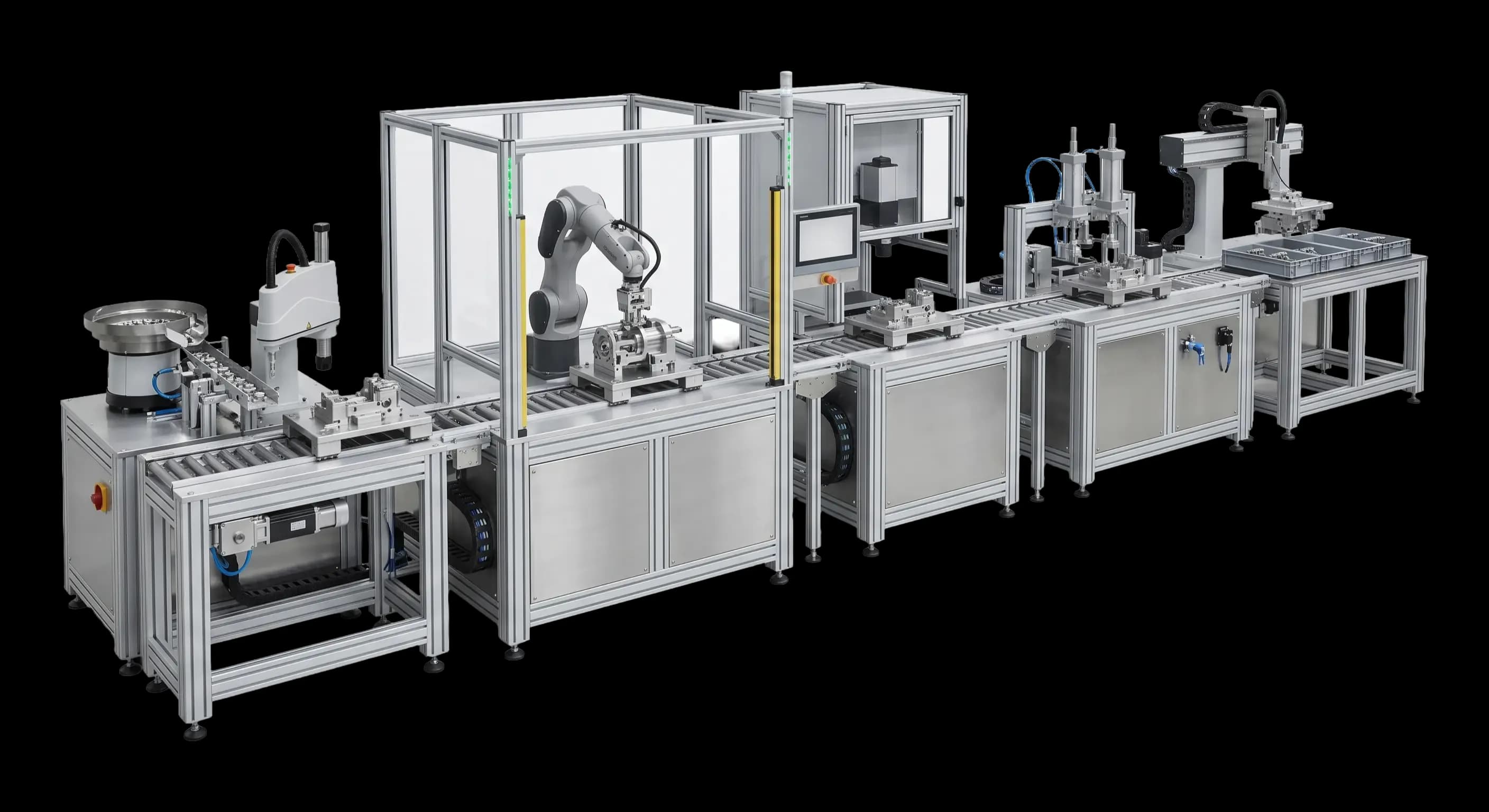
assemblean develops flexible production lines for small series that combine robotics, intelligent handling technology, modular process stations, and digital control systems into an adaptable manufacturing solution. This makes it possible to economically produce both recurring small batches and high-variant products — without the drawbacks of purely manual manufacturing.
Service overview
While mass-production systems are optimised for maximum volumes, production lines for small series must work as flexibly as possible. Product changeovers, different materials, or changing process sequences are part of everyday production. A rigid special-purpose machine would often not make economic sense. Instead, modular production concepts are used that can be adapted to new requirements — in software or mechanically — within a short time. Companies with high variant diversity in particular benefit from a flexible production line, since changeover times are reduced and smaller orders can be realised economically.
A modern small-series line combines automation with high adaptability.
| Analysis parameter | Advantage | Technological Implementation |
|---|---|---|
| High Variant Diversity | Manufacture different products on one line | Flexible robotics and recipe management |
| Short Changeover Times | Fast product changeover | Servo axes, quick-change systems, and digital parameters |
| Economic Efficiency | Automation even at small batch sizes | Modular manufacturing cells |
| Scalability | Expansion as production volume increases | Plug-and-produce concepts |
| Process Reliability | Consistent quality despite product changeovers | Adaptive process control |
| Transparency | Complete production data | MES, ERP, and OPC UA connection |
Every small-series production has different requirements for flexibility, cycle time, and variant handling. That is why every project begins with a detailed analysis of the product and the planned batch sizes.
The number of product variants, annual production volume, average batch size, and changeover frequency form the basis of every capacity and flexibility plan.
Changeover times, quality requirements, and necessary inspection processes determine how much automation makes economic sense.
Material flow and future product developments feed into the concept. We then develop a modular equipment concept that meets today's requirements while accounting for future product generations.
Already during the project phase, we simulate material flows and production processes to identify bottlenecks, optimise layouts, compare cycle times, and analyse changeover processes. Digital twins reduce project risk and significantly shorten later commissioning.
Unlike classic transfer lines, small-series lines often consist of modular manufacturing cells. A workpiece passes only through the process stations it actually needs.
The control software automatically recognises which product is being manufactured using barcodes, RFID, or serial numbers.
All process parameters are loaded independently — from machining programs and robot grippers to tool positions, inspection tolerances, dispensing quantities, screw parameters, laser programs, and markings.
Depending on the product, different processing paths are selected automatically. This allows different products to be produced one after another with almost no manual changeover.
Flexible production lines rely on versatile automation technologies. The modular design allows new processes or additional stations to be integrated at any time.

Cobots and classic industrial robots take on a wide range of tasks and can be quickly reprogrammed for new products.

Modular cells and quick-change systems enable the rapid integration of new processes and stations.

Flexible feeding systems and camera-based part recognition ensure process-reliable provisioning of the most varied geometries.

Servo-electric axis systems and smart workpiece carriers adapt to new product variants via software.

AMRs handle flexible material transport between manufacturing cells without fixed routing.

PLC, SCADA, and MES systems, edge computing, and OPC UA communication connect digital tool management and equipment control into one continuous system.
In small-series manufacturing, the biggest productivity losses often occur not during production, but during changeover. The faster these processes happen, the more economically the entire production line operates. assemblean reduces changeover times through automatic recipe management, digital tool data, quick-clamping systems, automatic calibration, flexible robot programs, standardised interfaces, and intelligent material provisioning — allowing product changeovers to happen within minutes.
Quick-clamping systems and standardised interfaces shorten mechanical tool changes to a minimum.
Digital tool data and automatic recipe management load the right machining programs without manual intervention.
Intelligent material provisioning and automatic calibration ensure the correct material supply for the new product.
Variant manufacturing is one of the biggest challenges for modern production lines. Our control software manages all product parameters centrally. As soon as a workpiece is identified, every station automatically sets itself to the required machining parameters — most of the manual changeover is eliminated.
Every product automatically activates the matching machining program and the required robot gripper.
Tool positions and inspection tolerances are adjusted per variant without manual readjustment.
Dispensing quantities and screw parameters adapt automatically to the respective product variant.
Laser programs and markings are loaded and documented on a per-product basis.
Frequent product changeovers must not affect product quality. That is why we integrate quality inspections directly into the production process.
Automated systems check dimensions, surfaces, assembly positions, completeness, and part presence.
Electrical functions, torques, and tightness are tested directly in the process depending on the application.
Markings and material properties are captured and automatically assigned to the respective product.
Robotics increases not only productivity but, above all, flexibility. While classic special-purpose machines can usually only perform a single process, robots take on a wide variety of tasks. New products often only require an adapted program instead of a completely new machine.
Robots handle assembly, loading and unloading, and pick-and-place tasks depending on the product variant.

Joining processes such as screwdriving, bonding, and dispensing can be adapted to new products with a simple program change.

Robot-assisted welding and laser processing ensure reproducible results across changing geometries.

Automated quality inspection and packaging complete the line all the way to shipping readiness.
Software is the heart of modern production lines. It connects machines, robots, sensors, and IT systems into a fully digitalised production environment.
Production planning and recipe management ensure every product is manufactured with the correct parameters.
Variant control, material tracking, and end-to-end traceability document every production step.
Quality management and OEE analysis make process performance and improvement potential visible.
Maintenance planning and energy data acquisition round off the digital production environment.
Many companies start with small production volumes. If demand rises later, the production line must be able to grow with it. This keeps the investment economically viable in the long term.
Further robots and process modules can be integrated into the existing equipment concept.
Parallel assembly cells and additional inspection systems increase capacity without redesigning the entire line.
Extended material logistics reliably supply additional stations and higher production volumes.
Higher automation levels and additional software functions unlock further economic potential.
Flexible production lines are used wherever products change frequently or are individually customised.

Mechanical engineering often produces customer-specific assemblies. Flexible production lines enable economical manufacturing processes despite low volumes.

Medical technology demands the highest quality standards at comparatively small production volumes. Automated production lines combine reproducible processes with complete documentation.

Electronic assemblies change in short innovation cycles. Flexible production lines enable fast product changeovers without extensive rebuilding.

Valves, sensors, connectors, or special assemblies are often manufactured in medium or small series. Modular production lines ensure economical manufacturing of the most varied variants.

Even highly individualised products can be partially automated. Our engineers determine the optimal degree of automation between manual work and full automation.
Process
A clear flow, one point of contact, and a well-coordinated manufacturing process.
We examine products, variants, batch sizes, material flow, and future requirements.
We create several automation concepts and compare them in terms of economic efficiency, flexibility, and expandability.
Simulations and virtual commissioning enable early testing of all process workflows.
Mechanics, robotics, control, safety technology, and IT systems are integrated on a turnkey basis.
After commissioning, we support your staff with training as well as optimising cycle times, quality, and equipment availability.
Flexible production lines have different requirements than classic transfer systems. assemblean does not develop standardised machines, but individual production systems precisely aligned with your products and manufacturing strategy.
Manufacturer-independent equipment planning and modular automation concepts instead of rigid special-purpose machines.
Robotics and cobot integration combined with special-purpose machine building from a single source.
Intelligent feeding technology, flexible material flows, and inline quality inspection for reproducible results.
PLC, SCADA, and MES development, brownfield integration, and virtual commissioning as well as continuous production optimisation.
Together we analyse your products, variants, and production goals. On this basis we develop a production line that combines short changeover times, high flexibility, and reproducible quality. Talk to our automation experts and find out how even small batch sizes can be automated economically.
FAQ
Flexible automation can already be economical for regularly recurring small series. Product complexity, variant diversity, and changeover effort are decisive.
Small-series lines are designed for flexibility and fast product changeovers. Mass-production lines, by contrast, focus on maximum output with largely constant products.
Yes. Modern production lines automatically recognise different products and switch all process parameters independently.
Modular manufacturing cells, cobots, flexible feeding systems, and software-based production control are particularly well suited.
Through automatic recipes, quick-change systems, digital tool management, and standardised equipment modules.
Yes. Existing systems can be integrated into a new production line via standardised interfaces or retrofit solutions.
Yes. Modular production lines can be expanded step by step and grow with increasing production volumes.
Production lines capture process data, quality data, OEE, energy consumption, traceability, maintenance information, and all production parameters in real time.
Knowledge hub


Trusted by


Book a personal meeting
Contact us now
© assemblean 2026 | All rights reserved.